
Iris ‘Jane Phillips’, also called Tall bearded iris ‘Jane Phillips’ was first introduced to British rose gardens by Dr Robert Graves in 1946. It is a rhizomatous clump-forming perennial with an upright growth habit.
Its leaves are attractive, strap-like, grow upright, and are greyish-green but it is most popular for its flowers that bloom in early summer. They are well-shaped with a clear azure-blue or pale violet-blue and white beards and softly ruffled petals that fall.
It is a fully-hardy deciduous perennial with a high toxicity level and therefore should not be ingested as it can cause serious intestinal discomfort.
How to grow Iris Jane Philips
Iris Jane Phillips is easy to plant and grow. To plant, place it in a shallow planting hole with the top part of the rhizome sitting on the surface of the soil. You can use a nitrogen-rich fertiliser to boost growth.
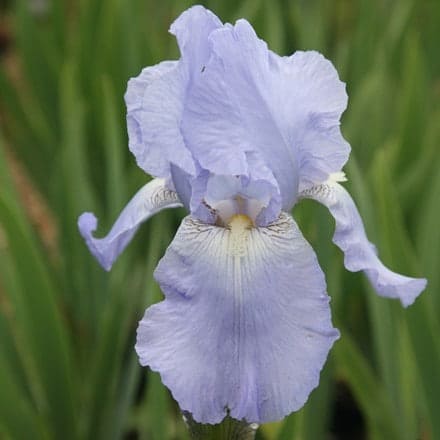
Iris Jane Phillips
After planting, you may remove the top-most part of the leaves on the rhizome to protect it against winds. When planting in an exposed area, stake it with bamboo canes early in spring. To encourage new growth, remove the stems after flowering to concentrate the plant’s energy towards producing new rhizomes.
Where should I position Iris Jane Phillips in my garden?
It is a hardy plant that can survive in temperatures as low as -20 degrees Celsius. Iris Jane Phillips should be positioned south-facing in full sun for maximum growth.
What is the height and spread of Iris Jane Philips?
Iris ‘Jane Phillips’ is a fast-growing plant that reaches its maximum height in as little as 2 to 5 years as long as the growing conditions are favourable. It grows about 2 to 3 feet in both height and diameter, while its flowers.
What kind of soil does Iris Jane Phillips need?
Iris Jane Phillips is pickier with soil type than most other plants but will do well in most soil types that other cultivars in the Iris genus will thrive in. Ideally, the best soil type for Iris Jane Phillip is sand or loamy soil, acidic or alkaline as long as it is well-drained.
Common problems with Iris Jane Phillips
It is generally easy to grow without many problems or hassle but be on the lookout for thrips, slugs, and snails.
