
IN THIS ARTICLE
Persicaria affinis “Darjeeling Red”
Persicaria affinis “Darjeeling Red” commonly called Knotweed “Darjeeling Red” is a semi-evergreen perennial and a flowering plant. Native to the Himalayas but is popularly grown in the UK and other regions. Additionally, it belongs to the genus Bistorta of the Polygonaceae family.
This species is low growing, mat-forming, and hardy. Oftentimes considered as long-living plants and mildly invasive. It was named for its likeness to the leaves of a peach tree, Prunus persica.
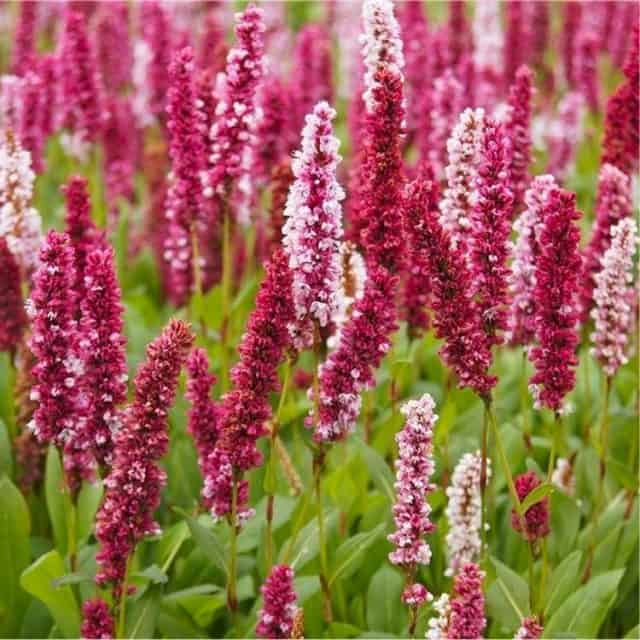
Persicaria affinis Darjeeling Red
“One of the best plants for ground cover we have seen. Rich reddish-pink flower spikes are produced above carpets of glossy, dark green foliage, turning bronze-red in winter. Flowering over a very long period, this plant is suitable in virtually any situation. “
It has large elliptic or lance-shaped green leaves that form a thick carpet that is good for ground cover. Plus, it produces long spikes of pinkish-white flowers during summer and autumn that eventually turns red as they mature. They can grow to a height of 30 cm with a spread of 60 cm. P.affinis is a pollinator plant that attracts pollen loving insects such as bees and butterflies.
Species of Persicaria
Persicaria amplexicaulis
Persicaria amplexicaulis (mountain fleece or red bistorta) is a herbaceous, perennial plant with small red flowers on thin long stems that reaches a height of 1.2m and grow from summer to autumn in damp regions.
It has heart-shaped leaves that grow together in clumps. As P.amplexicaulis loves water, it should be planted close to various water bodies such as ponds and streams. It is also easy to care for just like Persicaria affinis.
Persicaria milletii
Persicaria milletii (crimson knotweed) is a straight, semi-evergreen, perennial, linear to lance-shaped green plant with pronounced mid-veins that produces dense spikes of red bell-shaped flowers.
Crimson knotweed has a habit of clump-forming and it blooms in summer and reaches a height of 2ft. It is native to Nepal and China. It grows in any moist soil and requires full sun or partial shade.
Persicaria virginiana
Persicaria virginiana (Virginia knotweed or jumpseed) is a vigorous perennial spreading foliage mound of broad, ovate, green leaves that is native to Japan, Northeast United States and the Himalayas.
This knotweed plant that produces little white flowers on slender stems can grow up to 3 feet tall and 4 feet wide. It produces an oval dry seed that jumps off the stem at the slightest touch when it is ripe, hence the name jumpseed. It blooms in late summer and enjoys moist, well-drained soil.
Persicaria campanulata
Persicaria campanulata (lesser knotweed) is a robust plant that is deeply attractive with dark green leaves that have profound veins. Lesser knotweed is refined and elegant and produces lustrous clusters of fragrant, pale pink flowers. It grows happily in any soil and situation and blooms in late summer and autumn.
Cultivation of Persecaria
Persicaria affinis is very easy to grow and care for and it doesn’t need much fussing making it a very versatile plant that can be casually grown in a lot of places that other plants find difficult to grow and thrive in. It also has a lot of uses that will be mentioned later.
- Soil: P.affinis can grow and thrive in almost all soil types such as loamy, clay, sandy and chalky. Furthermore, it also does well in acidic, alkaline and neutral soil. It prefers moist but well-draining soil but tolerates dry soil.
- Light: It should be planted in full sun or partial shade and prefers an East, West or North facing position. It can be planted from autumn to spring and should also be fertilised in late winter or early spring with compost or manure to promote growth.
- Water: Persicaria affinis does not need a lot of water therefore it should be watered moderately.
Persecaria Propagation
It can be propagated by seed planting or by the division of large clumps in spring or autumn.
Controlling Persecaria
As Persicaria affinis is only mildly invasive there is not much need to prune but cutting back can be best achieved by cutting the flower stems in early spring or by just giving it a simple mow in late winter.
Where can I buy Persecaria in the UK or find for sale?
The best place I found it recently was here on Gardening Express
