
 |
Cycad – Learn, Buy & Grow ancient cycads in the UK
Cycads are woody plants resembling palms from the family Cycadaceae. Thriving in tropical and sub-tropical areas, cycads are known to originate from Japan, China, and North America, although they can be found in Central America, South America, Africa, Asia, and Australia.
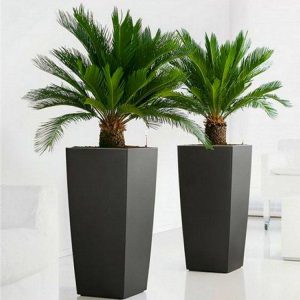
Giant Cycad – Cycas revoluta – King Sago Palm Tree Specimen
Referred to as “living fossils”, cycads are primitive plants that existed millions of years ago, even before the dinosaurs. This plant can be found in various habitats such as harsh deserts, semi-deserts, wet rain forests, sand, rocks, or even swamps, growing in either full sun, full shade, or both conditions.
It is a seed plant that can occur as both male and female species, with slow growth and a very long life span. It is usually stout and erect, with trunks up to 2-3 feet in diameter and large evergreen compound leaves that fall when older, forming a crown.
It is neither a flowering plant nor a fruit-bearing plant as the female species produce seeds while the male species produces cones filled with pollen.
Species of Cycad Plants
Cycads (such as this Cycas revoluta) belong to the Cycadales Order, which consists of three families: Cycadaceaea, Stangeriacaea, and Zamiaceae, and has about 300 species across them.
Despite the variety, some species are worthy of note.
Cycad revoluta Giant Cycad – Cycas revoluta – King Sago Palm Tree Specimen
Cycad revoluta is the most popular and most commonly cultivated species native to southern Japan. It is commonly referred to as the Cycad palm, Sago palm, or King Sago, and is found in tropical and sub-tropical regions, although widely grown as a houseplant. Known for its feathery foliage, it has deep green fronds which are stiff, glossy and might appear almost plastic in appearance. This species is more cold-tolerant but susceptible to damage by frost when the temperature is high; and tolerant to dry conditions, thriving indoors with the provision of abundant light. It can be variegated, but it rarely occurs like that. They can grow from 3 to 5 feet and can reach a height of 10 feet.
Growth and Care for Cycad Plants
Cycad plants are best planted in late autumn, early summer, and spring. Though slow-growing, they grow better just when the temperature is beginning to increase. They can produce new leaves periodically and may also take a break sometimes during spring.
Ultimately, they should be kept in moderate conditions and not be cultivated in extremely hot or cold weather to avoid damage to leaves and diseases.
Cycad plants are generally tolerant of most garden soils as long as they are free-draining. Multipurpose compost and organic matter are also welcome additions. The planting area can also be mulched to retain moisture.
Cycad plants especially thrive in warm, bright, natural light, but should be kept moderate as direct heat sources or natural light from the sun can burn the leaves.
They can also thrive in dry air and shade, provided the light levels are kept low, as is typical of the winter season. They require an average temperature of 70 degrees Fahrenheit.
Cycad plants require regular but limited water supply as excessive watering suffocates the cycad roots. Moisture levels should be maintained and kept consistent during the summer to prevent the soil from drying out completely and getting saturated.
Do Cycads need fertiliser? Where can I buy it?
Yes Cycads do need fertilser, we have more about Cycad fertiliser here
Winter care for cycads
Cycad plants remain dormant in the winter season. During winter, cycad plants should be watered sparingly and protected against frostbite.
Where to buy Cycads in the UK?
 Encyclopedia of Exotic Plants for Temperate Climates - Will Giles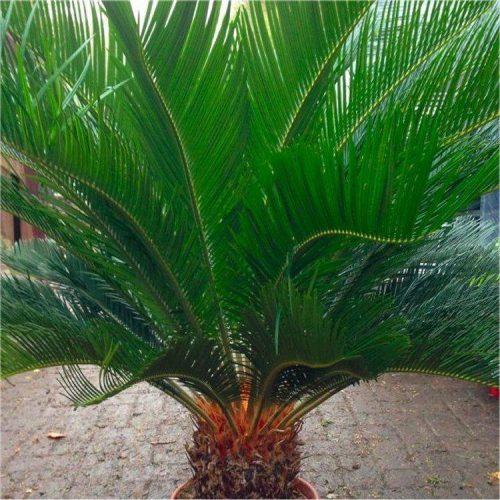
Cycas Revoluta - King Palm UK
King Sago Palm, commonly called Japanese Sago Palm is a very slow-growing palm-like evergreen perennial that has been around for over a million years and possibly longer, hence is regarded as one of the most primitive plants existing on earth. Contrary to the palm-like fronds of this plant, it is not a palm tree rather it is a cycad, one of the most popular species. This is obvious from its Latin name; Cycas Revoluta. Cycas revoluta is a species in the Cyca genus and a member of the Cycadaceae family that is found along hillside thickets and native to the Kyusha and Ryukyu Islands in Japan and Southern China.What is the King Palm Cycas Revoluta?
Cycad King Sago Palm features a rough, brown upright trunk holding up a beautiful rosette of evergreen, arching bipinnate leaves that are 2 to 5 feet long. On each side of the leaves, there are tapered, leathery, deep green to light green leaflets with needle-like tips and revolute edges, hence the name. Because of how slow this plant grows; it is unknown how long it takes to reach its ultimate height but most Sago palms around are about 3 to 10 feet in length and diameter. Furthermore, it is a dioecious plant which means that the male and female plants for reproduction to occur. The male plants can be identified by upright golden-brown inflorescences that are produced while female plants are identified by the tight clusters of red fruit that they produce. Lastly, it is known to be salt, drought, and frost resistant; tolerating temperatures of -6 degrees celsius for short periods, and that makes it a great plant to grow in the UK.Where to buy King Palm Cycas Revoluta In The UK
Cycad Dioon edule
Dioon edule, also known as chestnut edule or palma de la virgen, is a species native to the east coast of Mexico and distributed in Central America. It has long leathery foliage and is distinguished by the absence of spines on the leaflet border at maturation. It can grow up to 9 feet tall and can survive in containers. Lastly, the male and female species are very often not distinguishable until they develop cones, but the container-grown ones are less likely to produce seeds.
Cycad Encephalartos woodii
Encephalartos woodii, also known as wood’s cycad, is an African species with dark green, glossy leaflets which are sickle-shaped and broad. Being one of the rarest species in the wild, it is found in botanical gardens around the world as a clone of the male variant and can attain a height of 20 feet.
Cycad Zamia furfuracea
Zamia furfuracea, also known as cardboard palm, cardboard cycad, or Mexican cycad, is a plant native to Mexico's dunes. It is the second most popular cycad species in cultivation. This plant has thick, olive-green leaflets that are oval and have a circular crown of leaves that resemble palm fronds or ferns. Though stiff, the leaflets become erect in full sun and bend horizontally when in shade. The undersides are soft and fuzzy, feeling like cardboard when touched.
Cycad FAQs
What are some examples of cycads?
Examples of cycads include Sago palm, Zamia pumila, and Encephalartos species, among others.
Are cycads gymnosperms?
Yes, their naked seeds are left open to the air and directly fertilized by pollination.
Do cycads have flowers?
No, they do not produce flowers as their seeds are borne naked.
How deep should you plant cycads?
The depth of the plantation should be complementary to the height of the plant. A minimum depth of 12 inches is required for a plant that is up to 15 feet tall.
How to grow cycads?
Cycads thrive in moist, warm climates, although they can be suited and adapted to a variety of garden styles.
How to grow cycads from seeds?
After harvest, weak seeds should be removed before being planted, while warmth and moisture should be provided to acclimate the seedlings before placing them in a temporary position and eventually a permanent residence.
What is a cycad?
A cycad is an ancient hardy plant resembling a palm plant that bears male and female cones.
Are palm trees cycads?
No, they are commonly confused due to their similar overall appearance but belong to two different plant groups.
Can cycads grow in pots?
Yes, they grow in potting soil and terra cotta pots with a cactus mix, but they should not be re-potted often.
Do cycads like full sun exposure?
Yes, these plants are very adaptable and can thrive in full sun to partial shade, given the right environment.