Featured Exotic Plants
 Encyclopedia of Exotic Plants for Temperate Climates - Will Giles
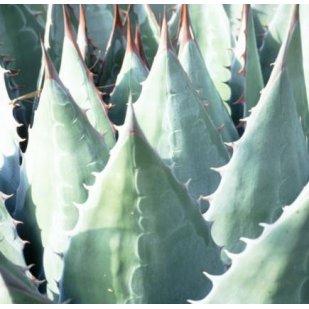 A relative newcomer only discovered in north-eastern Tamaulipas, Mexico, and described in the 1990s, but potentially the very best agave for growing in a cool-temperate garden. Spectacular plant forming a huge rosette 2m across in its native habitats, comprising hundreds of short, wide grey leaves, each beautifully marked and toothed, resembling a giant globe artichoke. In the wild grows as understory and emerging species in oak and pine forests at an altitude of up to 3400m, at which dizzy heights it regularly experiences heavy frosts, snow, ice, and damp mist for months on end during the winter, taking temperatures as low as –10°C and maybe –15°C, yet remains in pristine condition. Recent seed collections mean this plant is just starting to enter the European plant market. Probably the Agave most suited to our cool wet climate. Most Agaves can cope with very cold temperature but not too many cope so well with the cold and wet. Agave montana is a spectacular Agave that does it's very best in a hot sun-baked planting area in dry gardens, rock gardens or as a potted specimen. The key with growing Agave montana is to find a planting environment that is very well drained, and in full-sun. So when planting out Agave montana add additional grit or gravel to the planting hole to maximise drainage. In the colder parts of the UK and in colder than usual winters try to keep the Agave montana as dry as possible and free from a build-up of snow. Latin name: Agave Montana Common Name: Mountain Agave Ease of growing: Easy to moderate Position: Full sun Hardiness: Hardy especially if protected from winter Soil conditions: Exceedingly well drained gravely-sandy soil Buy Agave Montana online here, we offer many Agave's for sale in the UK.
 Asplenium scolopendrium - Hart’s-tongue fern. A very tropical looking evergreen fern native to Europe and the UK. It might be common but it is never-the-less very attractive, looking as though it should be growing on the floor of a jungle! It grows from 45-60cm tall with a similar width. It has multiple shuttlecock-like crowns composed of strap-like, leathery and very glossy bright green fronds up to 60cm long that are heart-shaped at the base, often with wavy margins on short stems. There are various cultivars available such as ‘Angustifolium’ which has fronds much narrower than the species. ‘Crispum’ has mid-green fronds with strongly wavy margins. ‘Crispum Bolton’s Nobile’ has broad fronds up to 45cm long. ‘Crispum Speciosum’ has sharply tapering fronds, occasionally with yellowish stripes. ‘Cristatum’ has much more divided fronds, each ending in a spreading crest. ‘Furcatum’ has lance-shaped fronds with a variable degree of undulation to the margins, with tips much divided and subdivided. ‘Muricatum’ has fronds distinctly wrinkled, puckered, and pleate They all prefer humus-rich, moist, well-drained alkali to neutral soils but will take slightly acidic soils. Most will take dry conditions for short periods only. Buy Asplenium scolopendrium online - Commonly known as Hart’s-tongue fern
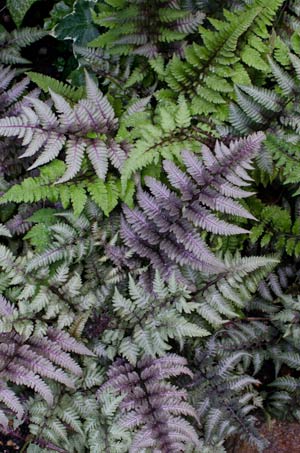 Athyrium niponicum var. pictum - Japanese painted fern - A very attractive deciduous fern from eastern Asia, growing from 25-35cm tall by 50-60cm wide, with short creeping reddish brown rhizomes. The fronds are pinnate, lance-shaped and arching, with silvery grey-green or mid-green tones up to 35cm long with with very prominent redish-purple midribs and yellowish stems. The variety pictum (Japanese painted fern) is truly stunning, one of the showiest ferns for the exotic garden, electrifying shady areas with its fronds 30-38cm long in a soft shade of metallic silver-grey with hints of red and blue. The variety pictum ‘Ursula’s Red’ has superb red-pink and silver fronds developing a blackish red central stripe as they mature. ‘Pictum Crested’ (painted lady fern) has purplish red midribs suffusing into silvery grey with bluish green lamina and crested pinnae—another excellent form. Common Name: Japanese painted fern Latin Name: Athyrium niponicum var. pictum Tenderness Rating: Hardy Ease of growing: Easy Position: Dappled to full shade Soil Condition: Fertile moist soil
 Dicksonia squarrosa online or Hard tree fern or even the Rough tree fern Wheki - A Suckering tree fern with a delicate appearance. Upright stem produces side crowns up the trunk, as well as underground runners producing side shoots, when mature. Faster growing than other dicksonias, up to a height of 8 m in the wild in its native New Zealand, though much smaller here in the UK as imports which are usually single stemmed. The trunk is covered in brown hairs and persistent frond bases. On mature plants the fronds can be from 1-3m long, though more like 0.5-0.8m here. The fronds are lance-shaped, bipinnate to pinnatifid, dark green and glaucous green underneath, with frond stalks covered in dense brown to black hairs. Dicksonia squarrosa prefers humus-rich, well-drained, moist soil in a humid, sheltered location, with plenty of water in the growing season. Never let the trunk dry out! Hardy to about –5°C for short periods, lower with protection. Excellent in containers or as a conservatory plant. = Latin Name: Dicksonia squarrosa Common Names: Hard tree fern, Rough tree fern, Wheki Tenderness Rating: Frost-hardy if well wrapped in cold weather Ease of growing: Easy Position: Part or full shade Soil Condition: Humus-rich, well-drained, moist soil Buy Dicksonia squarrosa online | Hard tree fern, Rough tree fern, Wheki