
Bamboo – Learn, buy and grow these fabulous plants
Here is a collection of easily grown bamboos that will give your garden a truly exotic feel. They are mysterious plants that are quintessentially oriental in their form evoking raked pebbles and stone lanterns with their upright habit and billowing foliage that catch the slightest of breezes…

Phyllostachys aurea – Golden Cane Bamboo
There has always been something quite exciting to me about bamboos, for years I didn’t grow them in my garden from the constant fear of them taking over my garden and never being able to control them later on. Eventually however I got an old copy of Paul Whittakers book on bamboos ( Hardy Bamboos: Taming the Dragon (2005) and found what I needed.
It is important to understand the differences between clumping vs running bamboos.
Fundamentally if you want a clump forming, non invasive bamboo that you can pretty much leave to its own devices then take a look at Fargesia. If you’re looking for those classic yellow culms, then Phyllostachys is a great choice, however these do need controlling to a certain extent. It’s one thing planting them in a huge garden with acres of space for them to roam, compared to a small normal sized garden where disappearing under the fence and reappearing 2 doors down causes awkward neighbour relationships from running rhizomes.
Bamboos have varying conditions for ideal growth, but they are not fans of saturated soil. They are quick to tell you that they need water, as the leaves curl at the edges. A good drink and they will be back to full form within a few hours. Most are actually evergreen bamboos.
Super impressive plants and one of my staples for a tropical garden.


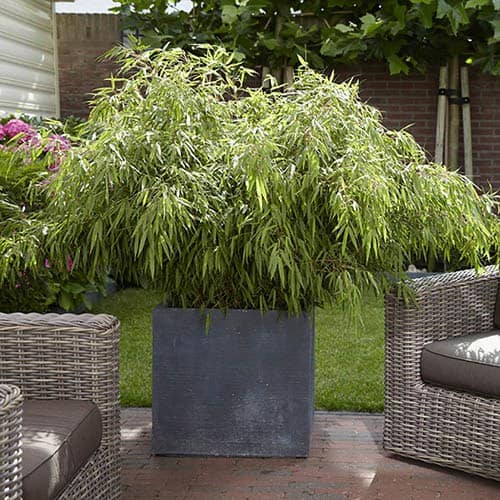

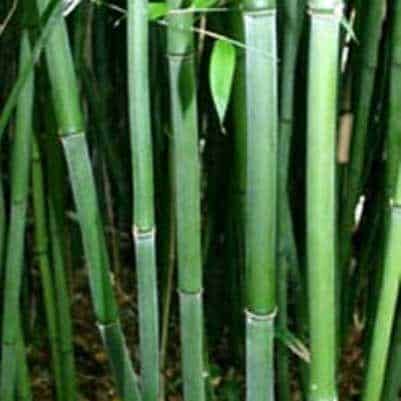


Can Bamboo Grow In Pots?
We already know bamboo plants to be fast growers and invasive which makes room for the assumption that they can only be grown in the ground. Well, contrary to the general assumption, bamboo can be grown in pots and containers and still grow successfully.
The two varieties of bamboo, running bamboo and clump-forming bamboo, can be planted in containers but may require slightly different care routines.
How can I grow bamboo in a pot or container?
Choose the right container: Choosing the right container for your potted bamboo is the first step for you to enjoy the entire process of growing bamboo in a pot. Ensure the container you pick can act as an impenetrable barrier for the bamboo roots since they can break through nearly anything. A metal or strong wooden container is ideal and plastic should not be considered.
Choose a location: Before planting move the containers to the spot in your garden where your bamboo will have enough protection from harsh winds, and frost that can cause leaf scorch, and still get sufficient sunlight to foster healthy bamboo stems.
Plant your bamboo: Put some gravel to the bottom of the pot to make it heavier, add a 50/50 mix of potting compost and sand. Next, prepare your rootball by using your fingers to loosen up the dense roots before planting. Soak the rootball in water for about 20 minutes then proceed to plant the rootball in the prepared pot. Water regularly, especially in hotter seasons.
Buy Bamboo Plants UK
Bamboo is an easy-to-grow plant that will lend height and structure to your garden. It thrives in most kinds of soil and requires little maintenance; smaller plants such as the Phyllostachys make decorative patio features, whereas the taller Red Stem Narihira is excellent for creating areas of screened privacy within your garden. Bamboo plants are also resistant to most common pests and diseases – all they really need to thrive is regular watering and a little fertiliser. Fundamentally there are two types of bamboo, clumping or running bamboo. Most bamboo grows very quickly, so great value for money.
Clumping bamboo is usually best for gardens, as it grows upwards, rather than the fast-spreading and more invasive running bamboo. However, if you live in a particularly exposed area, a running bamboo such as Phyllostachys aureosulcata f. spectabilis will thrive without too much spread. With good drainage, bamboo plants can also be kept indoors – if kept in an area with plenty of light, they’ll establish themselves quickly and add a pop of natural colour to your home. Phyllostachys Nigra is a good option if you’re looking to grow bamboo indoors.
Planting in the spring is ideal for bamboo, as this ensures it will produce fresh, sturdy canes in the summer months. Fertilising in early spring and again in late summer will maximise growth potential – adding a layer of mulch to your bamboo roots will also keep the plant healthy and strong. To show the plants at their best, trim the lower leaves and stems as close to the cane as possible; this also creates a good circulation of air.
There’s plenty of varieties of bamboo to choose from, so whether your garden is sunny, shady, or exposed, there’s bamboo for you.
Bamboo plants are beautiful plants with mostly straight colorful canes, native to many different forests and landscapes around the world . The colours of the bamboo canes depend on the species of the bamboo, some are yellow, others are green or brown. They create a beautiful exotic scene when planted as a foil or backdrop (or even in a main position) in your UK garden.
Though not all species of bamboo are invasive, they can be some of the most invasive plants in the world. The underground roots of bamboo can grow as far as 20 feet from the original clump, and once planted they start shooting clumps all around to form a bamboo forest of it’s own! Don’t be scared though, there is now more information than ever to inform you of the right choice for your garden.
Bamboo for sale in the UK
 Encyclopedia of Exotic Plants for Temperate Climates - Will Giles
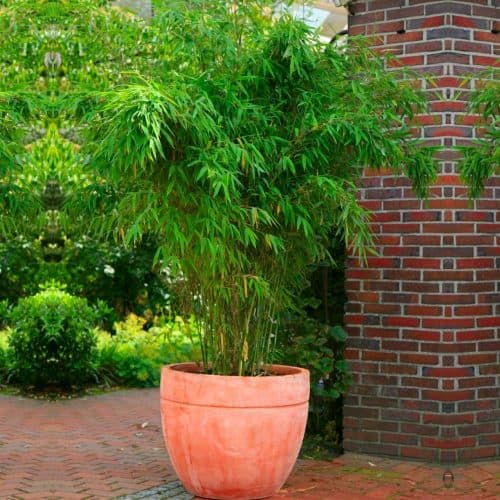 This medium-sized bamboo has yellow-green arching canes and a mass of soft mid-green leaves. One of the most popular bamboos the gracefully arching canes look lovely grown as an informal hedge. The plant's compact habit also makes it an ideal exotic specimen or container plant for small gardens. Supplied in approx 10 litre container pots at around 90-120cms tall.
Fargesia Nitida ‘Black Pearl'
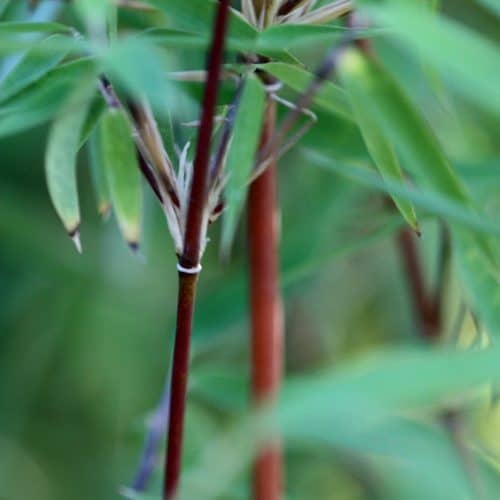
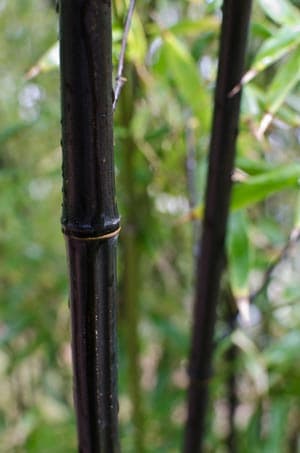
Fargesia Nitida ‘Black Pearl' also known as hardy black and purple bamboo but commonly referred to as Chinese fountain bamboo ‘black pearl' or just Fountain bamboo ‘Black Pearl’ is a hardy and majestic clumping bamboo that is non-invasive and is native to Szechwan, China. This handsome bamboo grows erect green canes that turn dark purple as they mature and arch at their tips which creates an elegant appearance. It has narrow lance-shaped green leaves that stay green in all seasons and form dense, lush foliage. It grows to reach 13 feet in height and 6 feet in a spread when it reaches maturity in 20 years. The canes themselves can vary in colour from a fresh green to a deep purple-black the stems can be so black that it is sometimes mistaken for a Phyllostachys nigra Black bamboo but Fargesia nitida ‘Black Pearl’ is a much tamer plant that will usually only grow around 3 to 4 metres high in a tight clump. Furthermore, it is also known by the nickname of ‘century plant’ as it blooms once every hundred years. This century plant is very ideal for both rural and urban locations and it copes very well with pollution and some exposure to the elements making it a very hardy and versatile plant. The canes of this plant can also be harvested when it has matured enough and used to build lightweight fences, make sieves and it can also be used to weave baskets, or used as plant support. This plant is perfect for use as a hedge when planted in partially shaded areas and it can also be used as a form of privacy screen as they can grow very dense but do not spread.Where to buy Fargesia Nitida ‘Black Pearl' and see for sale in the UK?
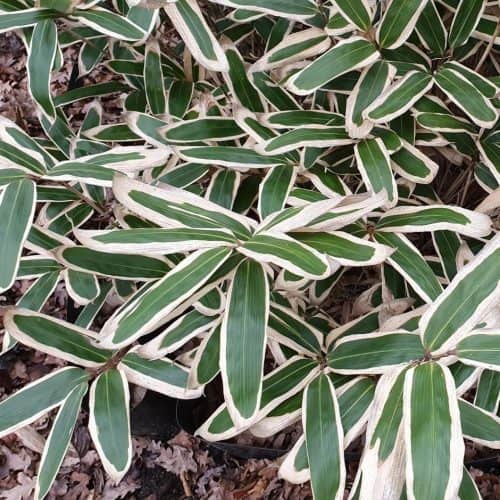
 Tall upright bamboo with grooved green canes that mature to brown-yellow and golden-green leaves. This bamboo is highly recommended as it is one of the least invasive large species. A great specimen plant it's best grown close to buildings or paths where the interesting distortions on the canes can be appreciated close-up. Contrasts beautifully with Phyllostachys nigra - the black cane bamboo. Position: full sun or partial shade Soil: humus-rich moist well-drained soil Rate of growth: average Leaves: golden-green Canes: grooved brown-yellow Other features: Ideal plant for a large container Hardiness: fully hardy This plant is supplied in an approx 5 Litre container at a height of around 100-120cms with colourful canes for good garden interest.
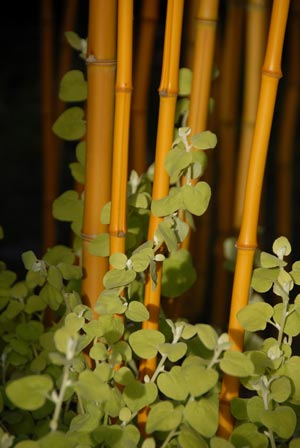
 Golden glossy canes with a green stripe above the branch bud contrasting with dark green leaves. In cold winters young canes will turn a stunning red if exposed to bright sunshine. This tall bamboo's upright habit makes it perfect for screening areas of the garden and growing as a bamboo hedge. Its fabulous multi-coloured canes also make it a striking and unusual feature plant. Supplied at around 130-150cms tall in approx 15 litre containers.



Bamboo FAQs


Types Of Bamboo Plants
Bambusa ventricosa (Buddha Belly Bamboo)
It is very popular around the Chinese regions and popular for its lumpy nodes that are assumed to be a replica of Buddha’s round belly. It is a non-invasive bamboo plant that is great for indoor plants and garden aesthetics. It thrives best in organically rich soil that is consistently moist. As it grows, the culm of the plant becomes overly large and you know it is time to leave it in dry soil and without much fertilisers. It grows well in warm temperate regions. If you live in a cold environment, it is best to keep the plant indoors to protect it from harsh weather.
Hedge Bamboo
A beautiful evergreen species of the bamboo plant. Hedges are popular for their beautiful smooth canes that develop from the blueish-green culms. Though as they grow they lose this vibrant colour and instead have a yellow-green appearance. They grow rapidly in a warmer climate and their canes can reach about 2 inches in width. They are one of the few species of non-invasive bamboo plants. Although, once planted they spread steadily, creating a mini bamboo orchard of 15-20 feet in width.
Japanese Arrow Bamboo
It is obvious from the name that this species of the bamboo plant is native to Japanese soil and also thrives best there. It can also be found in some parts of Korea, Florida and Connecticut.
In the past, Japanese samurai used the stiff canes from the tree to make arrows and that is probably how the name was gotten. It is an extremely hardy plant that thrives well in cold regions. Its leaves grow in yellowish-brown shade and can grow up to 13 inches to create some sort of shade just like palm fronds. Unlike many other bamboo species, the Japanese arrow bamboo can be grown in a container and equally withstand salty soil and air.
Often, bamboo plants are planted to be used as privacy screens but if you don’t understand the invasive nature of bamboo, it can quickly become a nightmare. Bamboo plants are exotic tropical plants that create a beautiful landscape, but remember to choose carefully especially if you are planning on keeping a bamboo plant as an indoor plant.
Bamboo FAQ
What are the types of bamboo plants?
Some of the most common types of bamboo plants are lucky bamboo, buddha bamboo, umbrella bamboo Guadua bamboo, etc.
Examples of invasive bamboo plants
The most common invasive bamboo types are golden bamboo, yellow groove bamboo, bissetti, red margin bamboo.
Examples of non-Invasive bamboo plants
The most common non-invasive bamboo types are fargesia
When is the best time to plant bamboo in the UK?
Spring is the best time to plant bamboo in the UK.
What bamboo plants are best for containers?
Any bamboo can be grown in containers
What are companion plants for bamboo?
Plants with contrasting leaf shapes are great companion plants for bamboo.
We love: Fargesia Nitida Black Pearl
Further Reading:
- Which Bamboo For Screening 2m+ High?
- How tall does bamboo grow and how fast does it grow?
- Is bamboo evergreen?
- Understanding Clumping vs Running Bamboo
We have further information on the following types of bamboo: Fargesia Asian Wonder, Fargesia murielae ‘Luca’, Fountain Bamboo Fargesia rufa, Phyllostachys aurea aureocaulis, Phyllostachys Bissetii, Pleioblastus Distichus and Pseudosasa japonica Arrow Bamboo.